

Every place has stories.
Make them accessible to everyone.
An open platform for any place people gather. Attach stories to the places that hold them, and they reach visitors automatically — no searching, no scanning.
The short version
What beacbeac does
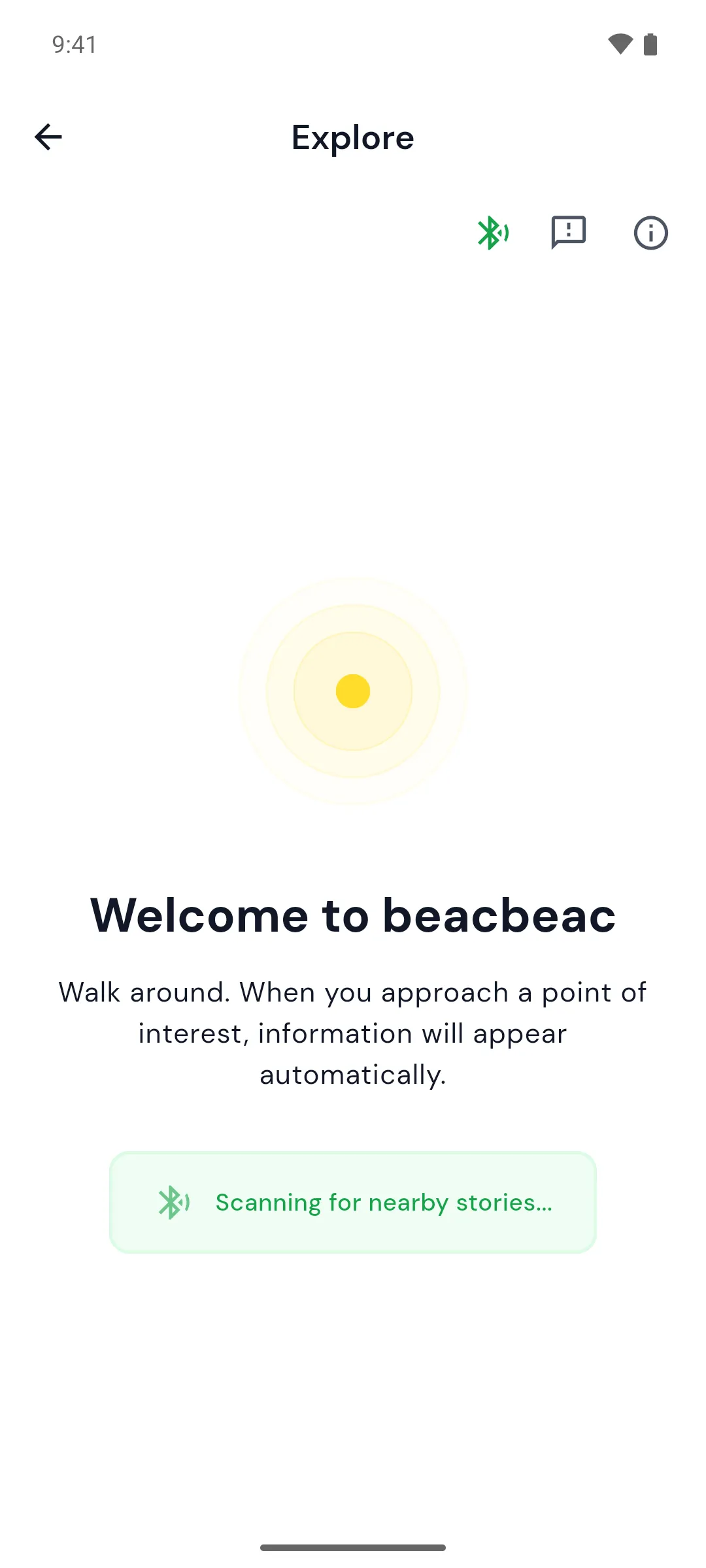
beacbeac is a Bluetooth-enabled platform that uses battery-powered beacons to deliver accessible, self-guided storytelling to all visitors — including blind, low-vision, Deaf, hard-of-hearing, and neurodiverse visitors — at museums, festivals, downtowns, parks, and other public places. Visitors download the beacbeac app once; after that, the right story plays automatically as they approach each point of interest, with no QR codes, no scanning, and no menu to search.
- Platform
- Bluetooth-enabled, using small battery-powered beacons placed on-site.
- Who it serves
- All visitors, including blind, low-vision, Deaf, and hard-of-hearing visitors.
- Where it is used
- Museums, festivals, downtowns, parks, and other public places.
- Setup for visitors
- One-time app download.
- How it works
- The right story plays automatically as a visitor approaches each point of interest.
- What it replaces
- No QR codes, no scanning, no menu to search.
The problem
The problem with how places communicate today
Most public places want to be more welcoming to visitors of all abilities. But the tools available to create that connection tend to create friction at exactly the wrong moment:
- Printed signage and guides assume the visitor can see them.
- QR codes require finding and scanning a code at every single stop.
- Traditional apps hand visitors a menu they have to search, point by point.
Who it’s for
Built for any public place
Museums & Galleries
Interpretation for collections, on every visitor’s own phone.
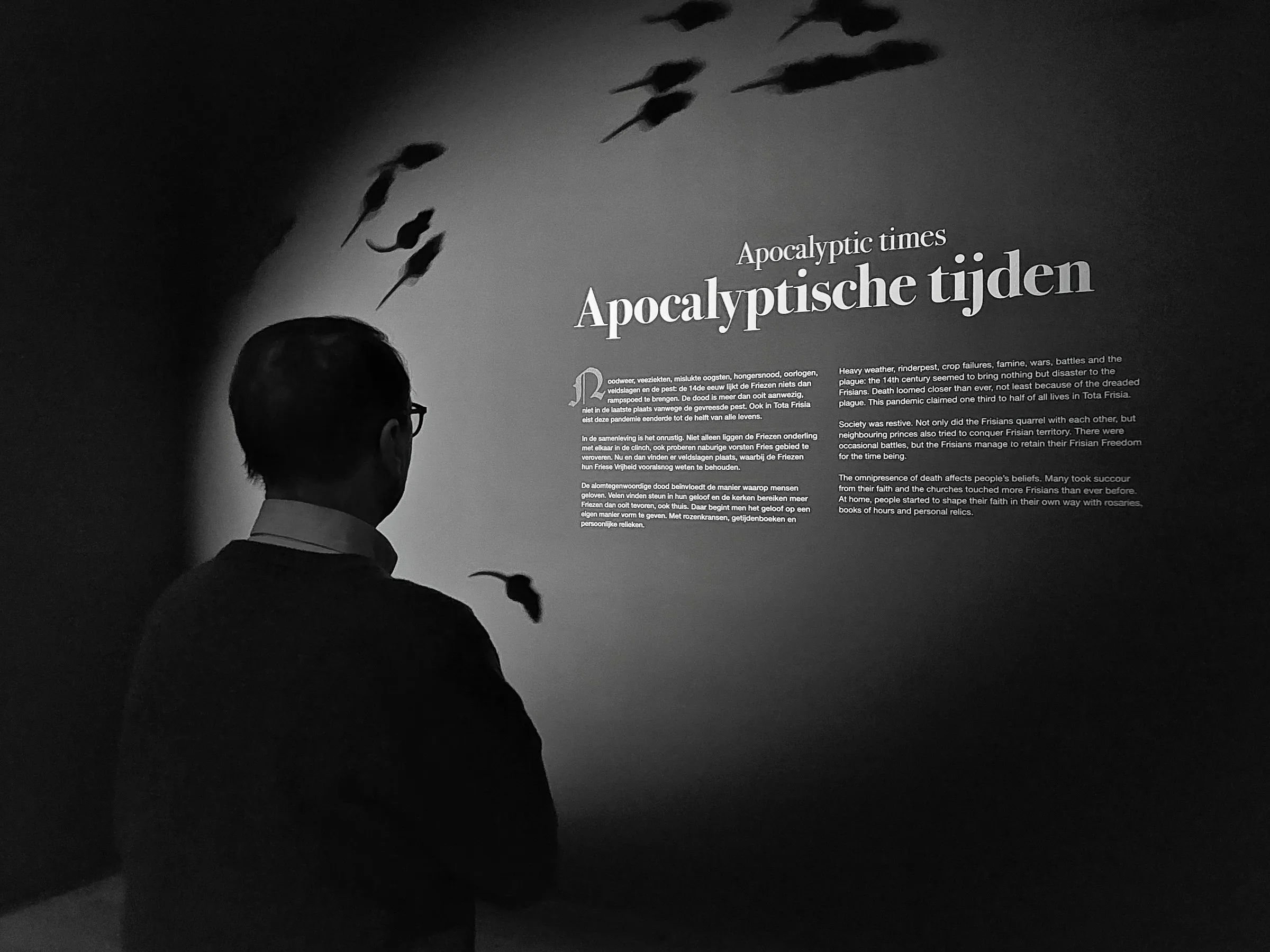
Where beacbeac was born. Wall text that reads itself, in three languages, arriving as visitors approach each work — with the beacon health, battery monitoring, and multi-site management that professional collections demand.
Festivals & Events
Accessible wayfinding and programming for temporary sites where permanent signage isn’t an option — and schedules can change on a dime.
Three days, forty artists, a site that didn’t exist last week. Drop beacons at every stage and installation, attach artist statements and schedules, and tear it all down on Monday — the stories redeploy next year in an afternoon.
Municipalities & BIAs
Accessible storytelling for downtowns, main streets, and public spaces.
Every storefront has a past. A business district or heritage walk becomes a self-guided tour: histories, architecture, voices of the neighbourhood — curated by the people who know it best.
Parks, Trails & Heritage
Weather-resistant interpretation for sites with no wiring and no network of their own.
Interpretive signage without the signs. Waypoints along a riverside path share what the eye can’t see — the history under the bridge, the species in the wetland — and speak it aloud for visitors who can’t read a trailside plaque, in the language they choose.
Gardens, campuses, community centres, sculpture parks — if people move through it, beacbeac can help them hear it.
Why beacbeac
Why beacbeac instead of the usual accessibility tools
Printed signage assumes visitors can see it
Static text assumes a level of sight, reach, or timing that not every visitor has.
The beacbeac solution
Content is heard, not just read — and it reaches the visitor wherever they are in the space.
QR codes make visitors do the work
Find the code, hold up a phone, scan it, wait, then find the right section — and repeat that at every single stop.
The beacbeac solution
One setup, then nothing to find and nothing to scan.
A bespoke app still has to be navigated
A venue-built app asks the visitor to search a menu, stop by stop. Without the ability to flex to their own way of reading, that menu may as well be invisible.
The beacbeac solution
The right content, in the format that visitor already uses, arrives as they approach.
Doing nothing has a cost too
For many places no accessible option is offered at all — not out of neglect, but because the alternatives feel expensive or complicated. Meanwhile, visitors who can’t use what’s there stop coming back.
The beacbeac solution
One scalable deployment that upgrades the experience for every visitor — not a checkbox, and not a capital project.
The mechanics
How it works
Mark the places.
Place small, weather-resistant, battery-powered beacons anywhere with a story to tell — a trailhead, a stage, a storefront, a sculpture. No wiring, no Wi-Fi, no infrastructure at the site.
Attach the stories.
Photos, descriptions, and audio, with text-to-speech built in so every story can be heard as well as read. Manage it all from a web dashboard: add, update, or retire a story without reprinting or redeploying anything. Run it with the team you already have.
Visitors just walk.
Visitors install the app once, at the entrance or the gate. After that the story arrives on their phone as they approach — automatically. No maps to decode, no plaques to squint at, no QR codes to hunt down, and no setup to repeat on the next visit.
It arrives the way they need it.
beacbeac works with the accessibility features already on a visitor’s phone — VoiceOver or TalkBack, text-to-speech, zoom, high contrast — and follows the language the phone is set to, in English, French, or Spanish. A story can carry text, audio, and video, including ASL video where you provide it.
Comparison
beacbeac vs. the old way
| Compared on | beacbeac | QR code | Static signage / print | Bespoke app | Do nothing |
|---|---|---|---|---|---|
| User effort | Low (one-time download) | High (scan at every stop) | High (not accessible) | High (download + navigate menu) | N/A (no experience offered) |
| Works for low-vision visitors | Yes | No (must find & read code) | No | Rarely (menu-dependent) | No |
| Works for Deaf / hard-of-hearing visitors | Yes — story text is always available | Depends (if code links to text) | Yes (if visible) | Depends (if captioned) | No |
| Updating content | Easy — dashboard, no reprint | Reprint codes | Reprint materials | App update & redeploy | N/A |
| Setup for temporary or pop-up events | Fast (portable, battery-powered) | Moderate (print & place codes) | Slow (produce & remove signage) | Slow (dev/CMS time per event) | None |
| Cost as you scale | Low (per-beacon rate steps down) | Low per code, but linear | High (labour at scale) | High (dev & maintenance) | None (but visitors lost) |
| Arrival cues and wayfinding | Some — proximity confirms arrival, not turn-by-turn navigation | None (a code cannot help you find it) | Static maps only | Varies (most have no real-time positioning) | None |
One row is deliberately not a win. Proximity confirms that a visitor has arrived at a point of interest; it is not turn-by-turn navigation, and a table where every row goes our way is a table nobody believes.
Enhance your visitor experience.
Get your quotePricing
Simple, transparent pricing
Published per-beacon rates, month to month. You pay the rate of the band each beacon falls in — like tax brackets — so the price per beacon steps down as a space grows. Built for year-round venues.
2-beacon minimum. $30 refundable deposit per beacon, once. All prices CAD.
See full pricing$40per beacon / month
- Your first 4 beacons
- $40
- Your next 4 (5 through 8)
- $35
- Every beacon after 8
- $25
Down to $25 a beacon at scale.
Built access-first
Access isn’t a feature we added. It’s the reason this exists. beacbeac was co-designed with Blind, Low Vision, Deaf, Deafblind, and disabled community members — so autonomous, personalized access to your space isn’t an afterthought. It’s the architecture.
- Nothing to hunt for. Stories arrive as visitors approach. No hard-to-find QR codes, no app-menu spelunking, no tiny map pins.
- Listenable by design. Every story can be read aloud with built-in text-to-speech — for low-vision visitors, tired eyes, or anyone who’d rather look up than down.
- An interface in three languages. The app follows the language already set on a visitor’s phone — English, French, or Spanish.
- Made with screen readers, not just tested against them. The app is built for VoiceOver and TalkBack from the ground up.
- Standards, not vibes. Designed to support the outcomes AODA is built around: removing barriers to information and experience for visitors with disabilities.
For your team
Run it with the team you have
- A real dashboard, not a science project. Manage beacons, stories, and status from the admin console in your browser, or from the app in the field.
- Know before visitors do. Beacon health, battery, and connection monitoring tell you when a unit needs attention.
- See how your space is used. Anonymous engagement analytics show which stories draw attention, how many visitors you reached, and how visits trend over time — evidence for your board, your funders, your next grant.
- Every organization is its own tenant. Your content, your team, your roles — isolated and secure.
- Works offline, syncs when you’re back. Built for basements, trails, and festival fields, not just gallery Wi-Fi.
- AI when you want it. Optional AI-assisted descriptions give small teams a head start on content.
Proof
Why trust beacbeac
beacbeac is by BluHeron Interactive, in collaboration with Centre[4]Arts — developed hand-in-hand with cultural institutions and co-designed with Deaf and disabled communities to make art more reachable. That work taught us something bigger: every public place is a collection, and every community deserves access to it.
Read our storyGrant-backed origin
beacbeac began as a Canada Council for the Arts–funded project, developed with Centre[4]Arts in Hamilton — vetted by a national funding body, and built inside a community arts organization already working with disabled communities.
Canadian-made and Canadian-hosted
Built by a Canadian company. Visitor engagement data is anonymous and lives in a Canadian data region — never sold, never rented, and never shared with third parties for their own purposes.
Independently audited, twice. An external accessibility specialist reviewed beacbeac in 2026 — 12 findings between the two audits, and all 12 are closed.
- The visitor app
- Audited June 2026 · 6 findings · all closed by July 2026VoiceOver and layout review on iOS. Every finding shipped with a test, so none of them can come back unnoticed.
- The operator handbook
- Audited July 2026 · 6 findings · all closed by August 2026Review of docs.beacbeac.com, the documentation your team uses.
Questions
Frequently asked questions
Does beacbeac require an app?
Yes — visitors download the free beacbeac app once. After that, everything happens automatically as they move through a space.
Does it work on iPhone and Android?
Yes, both. It is live on the App Store and Google Play today.
What languages does it support?
The app’s interface works in English, French, and Spanish, following the language already set on a visitor’s phone.
Do I need Wi-Fi?
You need Bluetooth switched on and a data connection — that can be Wi-Fi or the phone’s own data plan.
How many beacons do I need?
It depends on how many points of interest you want to bring to life. A beacon can carry a single story, or a small group of related pieces — useful when several works along one wall can share one beacon. Rates step down as you add beacons, with a 2-beacon minimum, and our team helps scope the right number for your space during onboarding.
How close does a visitor have to be to a beacon?
Detection range is set per beacon, using four presets from about 1 metre to about 15 — tight for closely spaced exhibits so they don’t trigger each other, wide for a standalone piece like a trailhead marker or a sculpture. Real range varies with mounting, walls, and crowds, so it is worth testing on site.
Does beacbeac help with AODA compliance?
We are not accessibility lawyers, but the platform is designed to support the outcomes AODA is built around: removing barriers to information and experience for visitors with disabilities. We recommend confirming the specifics with your organization’s accessibility compliance lead.
Does beacbeac meet WCAG standards?
WCAG is the benchmark most digital accessibility work is measured against, and it is one we take seriously in how we build.
Your space has stories. Let’s make them reachable.
For organizations & venues
Talk to us about bringing beacbeac to your space.
Bring beacbeac to your space